

Have You PayChecked?
Payroll questions. PayChecked answers.
Your payslip tells you much more than how much money will arrive in your bank account.
It shows how your pay has been calculated, what has been deducted, how much tax and National Insurance you have paid and, depending on your employer’s payroll system, other useful information such as your tax code, pension contributions and year-to-date figures.
But with so many numbers, codes and abbreviations, understanding a payslip isn’t always straightforward.
In this edition of Have You PayChecked?, we’re breaking down the key parts of a UK payslip and explaining what you should look for each payday.
What is a payslip?
A payslip is a record provided by your employer showing your pay for a particular pay period and the deductions that have been made from it.
In the UK, employers must provide employees and workers who are entitled to a payslip with one on or before payday. It can be provided electronically or as a printed document. GOV.UK payslip guidance confirms that payslips must show earnings before and after deductions, variable deductions such as tax and National Insurance and, where pay varies according to time worked, the number of hours worked.
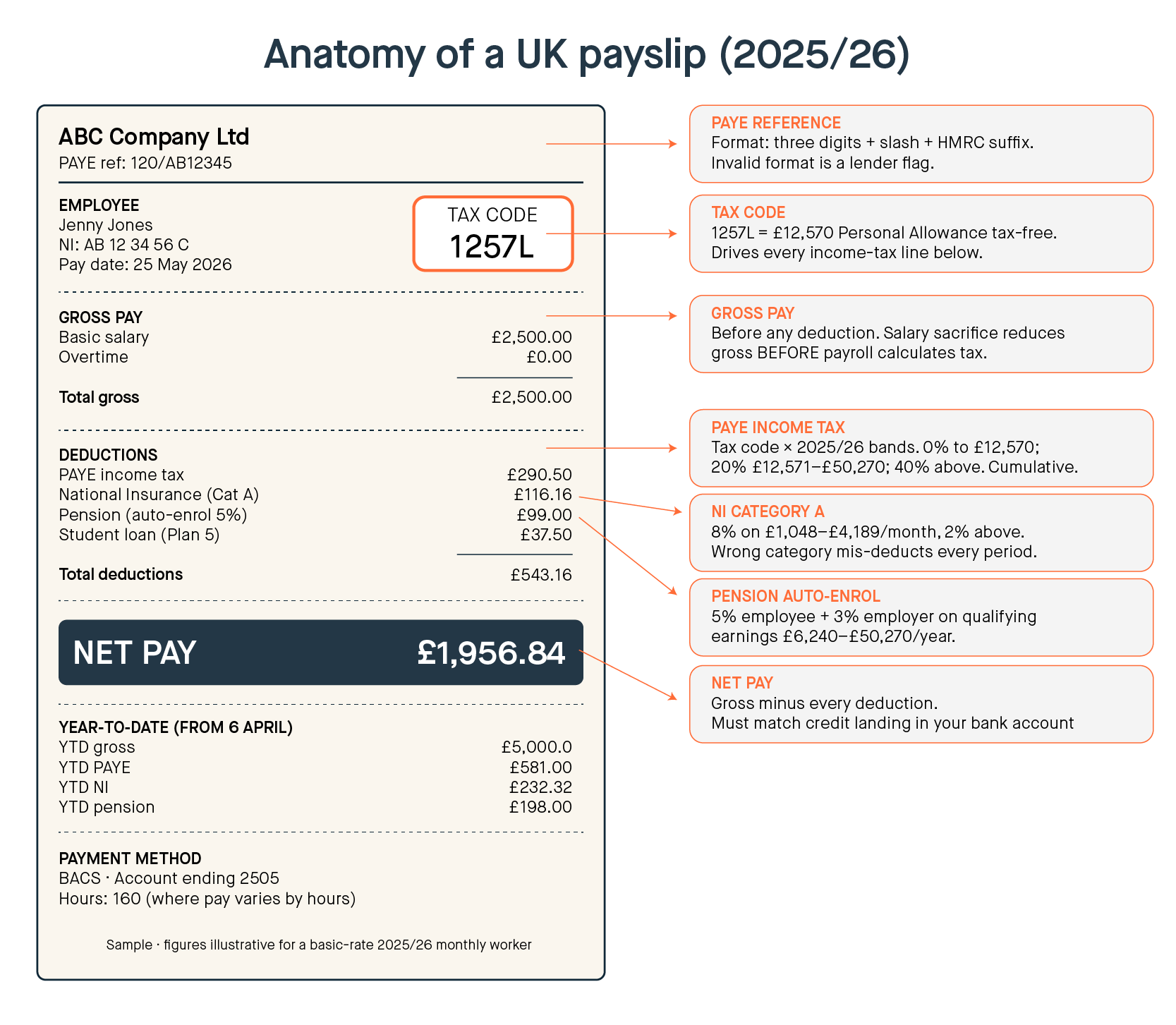
Your payslip can also be useful as evidence of your earnings, tax paid and pension contributions. Although payslips can look different depending on the employer and payroll software being used, you’ll usually find many of the following items.
How to read your payslip
Your personal and payroll information
Start by checking the personal information shown on your payslip.
Depending on your employer, this might include:
- Your name
- Payroll or employee number
- National Insurance number
- Tax code
- Pay date
- Pay period
- Job title or department
Not all of this information is legally required to appear on your payslip, so the exact layout will vary between employers. GOV.UK notes that employers may include additional information such as an employee’s National Insurance number, tax code and rate of pay. It’s worth checking that the information shown is correct, particularly your tax code.
What is gross pay?
Gross pay is the amount you’ve earned before deductions are taken from your pay.
Depending on your employment, your gross pay could include more than just your basic salary or wages.
For example:
- Basic pay
- Overtime
- Bonuses
- Commission
- Holiday pay
- Statutory payments
- Other additional payments
If you’re expecting overtime, a bonus or another payment that month, this is a good place to check whether it has been included. Your payslip must show your pay before deductions.
What are deductions?
Deductions are amounts taken from your gross pay before you receive your final net pay.
Common deductions can include:
- Income Tax
- Employee National Insurance contributions
- Workplace pension contributions
- Student loan or postgraduate loan repayments
- Salary sacrifice arrangements
- Other authorised deductions
The deductions you see will depend on your individual circumstances.
HM Revenue & Customs identifies tax, National Insurance contributions, pension contributions and student loans as examples of deductions you may see when reviewing your payslip.
If you see a deduction you don’t recognise, don’t simply ignore it. Ask your payroll or HR team what it relates to.
What does PAYE mean on your payslip?
PAYE stands for Pay As You Earn.
It’s the system used to collect Income Tax from employment income through payroll.
Your employer calculates the tax to deduct from your pay using information including your tax code and pays that tax to HM Revenue & Customs.
Your Income Tax deduction can change from one pay period to another depending on factors such as your earnings, tax code and individual circumstances.
What is your tax code?
Your tax code helps your employer determine how much Income Tax should be deducted through PAYE.
It will normally contain a combination of numbers and letters.
If your tax code changes, the amount of tax deducted from your pay could also change. HM Revenue & Customs recommends comparing the tax code on your payslip with the code it holds for you through its online Income Tax service or HMRC app if you want to check whether your tax is correct.
What is National Insurance on your payslip?
You may also see National Insurance, often shortened to NI or NIC, among your deductions.
If employee National Insurance contributions are due based on your circumstances and earnings, they will be calculated through payroll and deducted from your pay.
Don’t confuse your National Insurance contribution with your National Insurance number. One is an amount that may be deducted through payroll; the other is an identifier used for your National Insurance record.
You may also see an NI category letter on your payslip or payroll records.
What are pension deductions?
If you’re paying into a workplace pension, your payslip may show your pension contribution as a deduction.
Depending on the pension arrangement and how contributions are calculated, the figure you see on your payslip may not always be as simple as taking a percentage of your total gross salary.
This is why it’s worth understanding how your employer’s workplace pension arrangement works rather than trying to calculate your contribution based solely on your take-home pay.
Your payslips can also provide a useful record of the pension contributions shown through payroll.
What does year-to-date mean?
Year-to-date, often shown as YTD, gives you cumulative figures for the tax year up to your current payslip.
Depending on the payslip, this could include your:
- Total taxable pay
- Income Tax paid
- National Insurance
- Pension contributions
- Other cumulative payroll figures
For example, your monthly payslip might show your pay for November alongside the total amount you’ve earned so far during the tax year.
Year-to-date figures are useful because they give you a broader picture of your pay and deductions rather than showing only the current period.
What is net pay?
This is usually the figure everyone looks for first. Net pay is what remains after the relevant deductions have been taken from your pay.
In simple terms: Gross pay − deductions = net pay
Your payslip must show your earnings after deductions.Your net pay is therefore the figure to compare with the amount you expect to receive, subject to how your employer handles any separate payments or adjustments.
What should you check on your payslip every payday?
Rather than looking only at your net pay, take a few moments to check the rest of your payslip too.
A useful five-point check is:
- Check your gross pay
Does it reflect the salary, hours, overtime, bonus or other payments you were expecting? - Check your tax code
Has it changed since your previous payslip? If it has, do you understand why? - Check your deductions
Look at Income Tax, National Insurance, pension and any other deductions. - Check your net pay
Does the amount look right based on your earnings and deductions? - Check anything you don’t recognise
If a figure, deduction or change doesn’t make sense, speak to your payroll or HR team rather than leaving it until later.
Why has my net pay changed if my salary is the same?
This is a common payroll question. Even if your basic salary hasn’t changed, your take-home pay can sometimes be different.
Possible reasons include changes to your:
- Tax
- Tax code
- National Insurance
- Pension contributions
- Student loan deductions
- Benefits or salary sacrifice
- Overtime, bonuses or commission
- Other payroll adjustments
So if your take-home pay changes unexpectedly, compare your latest payslip with the previous one and look at what has changed, rather than checking only your net pay.
What should you do if your payslip looks wrong?
If something doesn’t look right, the first step is usually to contact your employer’s payroll or HR team.
Explain which part of the payslip you’re querying and, where possible, provide the relevant pay period and payroll number.
If you think the issue relates specifically to your tax, you can also check the tax code held for you by HM Revenue & Customs. HMRC recommends comparing the tax code on your payslip against the code shown in its online service or HMRC app.
Keeping your payslips also gives you a useful record if you need to look back at previous earnings or deductions.
Have You PayChecked?
Your payslip shouldn’t just be something you open to find your take-home pay.
It provides important information about what you’ve earned, what’s been deducted and how your final pay has been calculated.
So next payday, take an extra minute to look beyond the number going into your bank account.
- Check your gross pay.
- Check your deductions.
- Check your tax code.
- Check your net pay.
Have You PayChecked?
Payroll questions. PayChecked answers.

Insights from Payroll Master
Lee Baldwin | Director of Managed Services
Disclaimer: PayCheck does not provide accounting, tax, business or legal advice. This guide has been provided for information purposes only. You should consult your own professional advisors for advice directly relating to your business or before taking action in relation to any of the content provided.