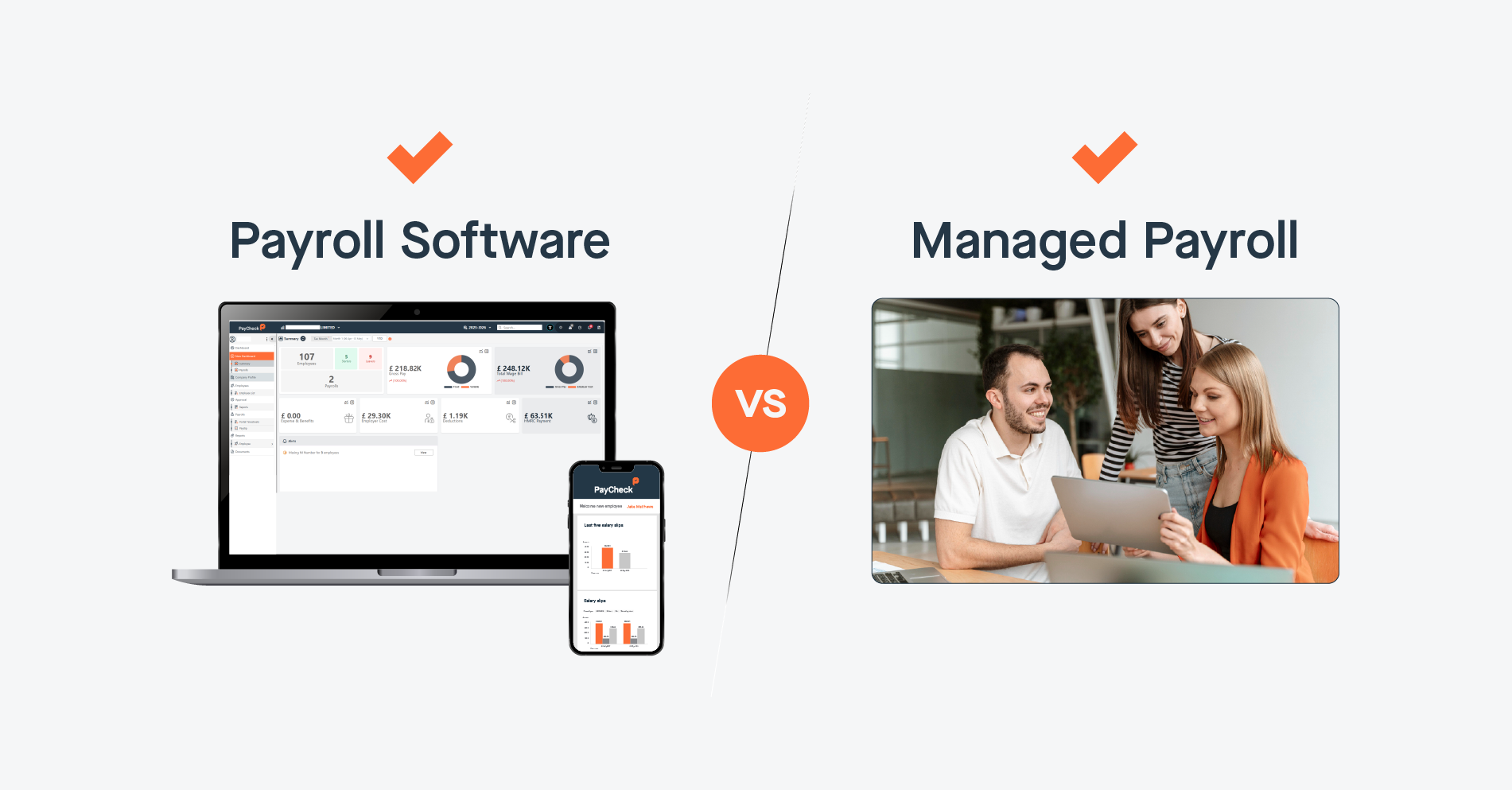

Choosing between payroll software and a fully managed payroll service is an important decision for any UK employer.
Both options can calculate employee pay, generate payslips and support HMRC reporting. However, the level of responsibility retained by your business is very different.
With payroll software, your internal team still manages the payroll process. The technology helps with calculations and submissions, but your business remains responsible for entering accurate data, interpreting legislation, handling exceptions, checking results and meeting every deadline.
With fully managed payroll, a specialist provider uses payroll technology and professional expertise to manage the process on your behalf.
The right choice depends on the size and complexity of your workforce, the expertise available internally and how much time your finance or HR team can realistically dedicate to payroll.
Quick answer: payroll software or fully managed payroll?
Payroll software may be suitable if you have simple payroll, experienced internal staff, enough time to complete checks and a strong preference for retaining day-to-day control.
Fully managed payroll may be more suitable if your payroll is becoming complex, your internal team is stretched, your payroll specialist is leaving, or you want expert support with HMRC reporting, pensions, statutory payments, year-end tasks and employee queries.
The key distinction is not whether software is used. Both approaches rely on software. The real difference is who operates the payroll, manages exceptions and takes responsibility for the monthly process.
What is payroll software?
Payroll software is a digital system that helps an employer calculate and administer payroll internally.
Depending on the platform, it may calculate gross-to-net pay, Income Tax, employee and employer National Insurance, student loan deductions, statutory payments and pension contributions. It may also generate electronic payslips, P45s and P60s, and transmit Real Time Information submissions to HMRC.
UK employers normally send a Full Payment Submission each time they pay an employee. The submission contains details including employee pay, tax, National Insurance, statutory payments, starter information and leaver information. An Employer Payment Summary is used for specific adjustments, recoveries and periods in which no employees were paid.
Payroll software makes these tasks faster, but it does not remove the employer’s operational responsibilities. Someone within the business must still collect the information, update the system, review tax codes, enter variable pay, manage starters and leavers, check pension treatment, approve the final payroll and respond to discrepancies.
In other words, software provides the tool. Your team still provides the payroll expertise and time.
What is a fully managed payroll service?
A fully managed payroll service transfers much of the recurring payroll administration to an external payroll provider.
The employer supplies authorised payroll changes, such as new starters, employee departures, salary amendments, bonuses, overtime and absence information. The payroll provider then processes the payroll, performs checks, produces reports for approval and completes the agreed submissions and documents.
A comprehensive managed payroll service may include:
- Gross-to-net payroll calculations
- PAYE and National Insurance administration
- RTI submissions to HMRC
- Electronic pay slips
- Workplace pension assessments and contribution files
- Statutory payment calculations
- Starter and leaver administration
- P45 and P60 production
- Payroll reports and accounting journals
- Benefits in Kind and P11D support
- Year-end reconciliation
- Employee payroll query support
The precise scope varies between providers. Some payroll bureau process only the data supplied by the employer. A genuinely fully managed service may also review exceptions, flag missing information, support pension administration and provide guidance when unusual payroll situations arise.
It is therefore important to compare the service specification rather than assuming every outsourced payroll package provides the same level of support.
Payroll software vs fully managed payroll: the main differences
Area | Payroll software | Fully managed payroll |
Payroll processing | Completed internally | Completed by an external specialist |
Software operation | Managed by your team | Managed by the provider |
Data collection | Internal responsibility | Internal data supplied through an agreed process |
Payroll expertise | Must be available internally | Provided as part of the service |
HMRC submissions | Internal team submits | Provider normally submits on your behalf |
Pension administration | Usually managed internally | Can be included in the managed service |
Legislative monitoring | Internal responsibility | Provider monitors payroll changes |
Employee queries | Managed internally | May be supported by the provider |
Holiday cover | Business must arrange cover | Supported by the provider’s wider team |
Monthly cost | Usually lower headline cost | Higher fee but less internal workload |
Control | Direct operational control | Control retained through review and approval |
Scalability | May require more internal resource | Service can scale with employee numbers |
Even when payroll is outsourced, the employer remains responsible for ensuring its obligations are met. Outsourcing does not remove the need for governance, accurate source information or final approval. It changes how the work is delivered and gives the employer access to specialist support.
The benefits of payroll software
Lower headline cost
Payroll software will often have a lower visible monthly or annual cost than a fully managed service.
For a small employer with a basic monthly payroll, limited employee changes and someone internally who already understands PAYE, payroll software may be economical. Basic UK payroll software can start from relatively low monthly subscription fees, while fully managed services are commonly priced by employee numbers, pay frequency and complexity.
However, the subscription price should not be mistaken for the total cost of payroll. Employers must also account for staff time, training, checking, holiday cover, corrections and the cost of managing employee queries.
Greater direct control
Running payroll internally gives the employer immediate control over input, timing and reporting.
Some businesses value the ability to make last-minute changes directly, produce custom reports and retain payroll knowledge within their finance or HR team. This may be particularly useful where payroll information changes frequently and the business has a skilled payroll professional available.
Integration with business systems
Many payroll platforms connect with accounting, time and attendance, HR and pension systems.
Good integration can reduce duplicate data entry, improve reporting and make it easier to reconcile payroll with finance records. Employee self-service can also allow staff to access payslips and year-end documents without contacting HR.
Automation of routine calculations
Software can automate many repetitive steps, including tax calculations, National Insurance, student loan deductions and pension contributions.
This helps reduce basic calculation errors. But automation is still dependent on correct employee information, configuration and interpretation. A system may calculate an incorrect result perfectly if it has been given the wrong data or settings.
The limitations of payroll software
Your business still needs payroll expertise
Payroll software does not decide whether a worker has been assigned the correct National Insurance category, whether an apprentice has moved to a different minimum wage rate, or whether a payment should receive a particular tax treatment.
The software processes the instructions and configuration provided to it. Someone must understand the legislation well enough to enter the correct information and assess whether the output is reasonable.
This distinction matters because RTI requires payroll data to be sent to HMRC when or before payment is made. Each payroll run is therefore also a reporting event, not simply an internal calculation.
Payroll consumes more time than the software demonstration suggests
Running payroll includes much more than clicking a button.
Before processing begins, someone must gather overtime, bonuses, commission, absences, new starter details, leaver information, attachment orders and pension changes. After processing, someone must review reports, investigate variances, obtain approval, arrange payment, submit information and answer employee questions.
Research published in 2026 found that 77% of surveyed payroll professionals lost up to 11 hours each week to inefficient processes or technology, while 70% used multiple payroll systems, averaging 3.2 systems per team.
The amount of time required will vary significantly, but the wider point remains: buying software does not remove the internal payroll workload.
Reliance on one person creates continuity risk
In many SMEs, one payroll administrator, accountant, bookkeeper or Finance Manager understands the process.
If that person goes on holiday, becomes ill, resigns or retires, the employer can be left with software but no one who confidently understands the settings, deadlines, exceptions or historical decisions. A fully managed service reduces this key-person dependency by placing payroll delivery with a broader specialist team.
Compliance responsibility remains internal
Payroll legislation and HMRC requirements change regularly. The internal payroll operator must keep systems updated and understand how changes affect employees.
A 2025 survey of 1,000 UK SME leaders reported that 84% had experienced payroll errors and 40% had incurred penalties. The most reported issues were incorrect wage calculations, late or missing payments, incorrect hours and tax calculation errors.
These findings do not mean software is ineffective. They show that payroll accuracy depends on the combination of appropriate technology, reliable processes and knowledgeable people.
The benefits of fully managed payroll
Access to specialist payroll knowledge
A managed payroll service provides access to professionals who work with UK payroll rules every day.
This is valuable when dealing with statutory payments, directors’ National Insurance, Benefits in Kind, attachment orders, pension assessments, irregular pay, payments after leaving or corrections to earlier submissions.
Rather than expecting the Finance Controller or HR Manager to research each exception, the business has specialists available to identify the correct treatment.
Less administration for finance and HR
Outsourcing removes much of the recurring processing workload from the internal team.
The employer still needs to supply accurate and approved changes, but the provider can manage calculations, submissions, documents and agreed pension processes.
This allows finance professionals to spend more time on forecasting, cash flow, margin analysis and management reporting. HR teams can focus on workforce planning, employee engagement and retention rather than payslip production and payroll corrections.
Industry estimates suggest outsourced payroll can reduce payroll administration substantially, although the actual saving depends on service level, payroll complexity and the quality of the transition.
Better business continuity
A fully managed payroll provider offers team-based continuity.
Payroll is no longer dependent on one internal employee being available at the right time. This can be particularly valuable when a long-serving payroll person is leaving or retiring and the business wants to preserve its existing workflow without recruiting a direct replacement.
A well-managed onboarding process should capture payroll knowledge, document recurring requirements and establish clear dates for data submission, review and approval.
Ongoing compliance support
Specialist providers monitor payroll-related changes and incorporate them into their processes and systems.
This may include changes to National Minimum Wage rates, statutory payment rates, National Insurance thresholds, RTI reporting and Benefits in Kind requirements. The employer still needs to provide accurate source data and make business decisions. However, the provider can help identify risks and ensure technical payroll treatment reflects current requirements.
Greater scalability
Payroll complexity rarely grows in a perfectly straight line.
A business may add new pay frequencies, bonuses, benefits, pension arrangements, departments or locations. Employee turnover can also increase the number of starters and leavers requiring attention. A managed payroll service can normally absorb this growth without the employer recruiting and training additional payroll staff. The cost may rise with employee numbers or complexity, but the operating model remains scalable.
Responsive human support
When payroll is urgent, clients often need more than a knowledge article or support ticket.
They may need help understanding a tax code, correcting a salary, processing a leaver or resolving an HMRC discrepancy before payday.
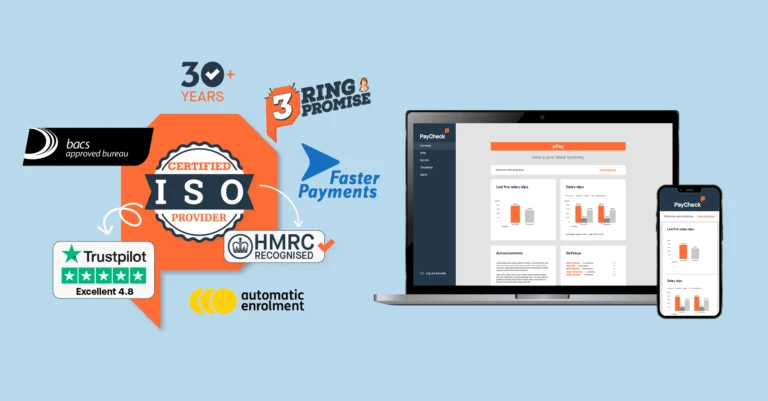
At PayCheck, clients receive human-led payroll support backed by the 3 Ring Promise, meaning client calls are answered by the support team within three rings. This service model is designed for businesses that value direct access to experienced payroll professionals alongside modern payroll technology.
The possible limitations of fully managed payroll
A higher visible monthly fee
A fully managed service normally costs more than a software licence because the fee includes professional processing and support.
Indicative UK market research places basic outsourced bureau services at around £4 to £12 per payslip or employee, while more comprehensive managed services can cost more depending on pensions, pay frequency, Benefits in Kind, BACS, employee queries and wider compliance support. Pricing varies significantly, so employers should request a written service breakdown rather than compare headline figures alone.
The fairest comparison is:
software cost + internal time + training + cover + correction risk
versus:
managed service fee + remaining internal approval time
The employer must follow agreed cut-off dates
A managed service needs clear deadlines for submitting changes and approving payroll.
Businesses accustomed to making last-minute adjustments may need to adopt a more structured process. This is usually beneficial for accuracy, but it requires managers to supply information on time. The provider should also explain how urgent corrections and exceptional payments are handled.
Service quality varies
Not all providers offer the same experience.
Some offer a dedicated payroll manager and telephone support. Others operate through central queues or online tickets. Some include pensions, P11Ds and employee queries, while others charge separately. Businesses should assess the people and service model behind the technology, not just the feature list.
Which option costs less?
Payroll software usually wins on headline price. Fully managed payroll may deliver better overall value when internal time and risk are included.
Consider a Finance Manager who spends six hours per month collecting changes, running payroll, reviewing results, completing pension administration and answering queries. That equals 72 hours annually before year-end activities, P11Ds, corrections or legislative research.
The internal cost is not only the employee’s hourly salary. It is also the opportunity cost of work not completed elsewhere.
A growing business may obtain more value by redirecting that time towards forecasting, financial controls or growth initiatives, even if the managed payroll invoice is higher than the software subscription.
How to decide which option is right for your business
Payroll software may be the right choice where:
- The payroll is relatively simple
- Employee numbers and changes are low
- A trained professional payroll is available internally
- The business has reliable holidays and sickness cover
- Internal control is a high priority
- The team has time for compliance updates and monthly checks
Fully managed payroll may be more appropriate where:
- Payroll is consuming too much finance or HR time
- Employee numbers or pay arrangements are growing
- The business has frequent starters, leavers or variable payments
- Pension administration creates additional workload
- The current payroll person is leaving or retiring
- The organisation has experienced payroll errors
- Managers want dedicated specialist support
- Business continuity and compliance are priorities
Neither model is automatically better. The best choice is the one that gives your business the right balance of control, cost, expertise and resilience.
Questions to ask before choosing payroll software
Before buying software, establish who will be responsible for operating it and how cover will work.
Ask whether the platform supports your pay frequency, pensions, statutory payments, benefits and accounting integrations. Review how RTI errors are corrected, how updates are implemented and what support is available when an unusual payroll issue arises.
It is also worth testing the full monthly process, not only the calculation screen. Examine how data is collected, approved, reconciled and stored.
Questions to ask a fully managed payroll provider
Ask the provider to define exactly what “fully managed” means.
The proposal should clarify whether the service includes RTI, pensions, P45s, P60s, P11Ds, employee queries, reports, payroll journals and year-end work. It should also explain onboarding fees, cut-off dates, approval workflows, urgent corrections and data security.
Most importantly, establish who you will contact when help is needed and how quickly the provider responds.
How PayCheck supports fully managed payroll
PayCheck provides fully managed payroll services for UK businesses that want to reduce administration without losing visibility or control.
The service can include payroll calculations, RTI submissions, electronic payslips, workplace pension administration, starter and leaver processing, year-end documents, Benefits in Kind support and access to experienced payroll professionals.
The workflow is structured around client review and approval. This means the business remains informed and in control, while the detailed processing and compliance administration are handled by payroll specialists.
With nearly 30 years of experience, support for more than 1,500 UK businesses and the PayCheck 3 Ring Promise, the focus is to combine reliable payroll technology with responsive human expertise.
Speak to a PayCheck payroll expert
If payroll is consuming too much time or creating unnecessary risk, speak to PayCheck about a fully managed payroll service built around your existing workflow.
Our Payroll Masters can help you assess your current process, identify what can be outsourced and create a managed service that keeps your business informed, compliant and in control.

Insights from Payroll Master
Jason Emanuel | Head of Sales
Frequently Asked Questions
Is payroll software the same as outsourcing payroll?
No. Payroll software is a tool used by your internal team to process payroll. Outsourcing transfers defined payroll activities to an external provider.
Is fully managed payroll suitable for a small business?
Yes. It can be particularly useful for small businesses where hiring a full-time payroll professional is not cost-effective or where payroll is currently being handled by a director, accountant or office manager.
Does outsourcing payroll remove the employer’s legal responsibility?
No. The employer retains legal responsibility for meeting payroll and employment obligations. A provider supports delivery and compliance, but the employer must supply accurate information and maintain appropriate oversight.
Can a managed payroll service handle workplace pensions?
Many providers can assess workers, calculate contributions and produce or submit pension files. Employers should confirm whether direct submission to their pension provider is included.
Can payroll be outsourced without changing accounting software?
Often, yes. A flexible payroll provider should be able to supply reports or journals compatible with common accounting systems. Integration requirements should be discussed during onboarding.
Will my business still approve payroll?
A reliable managed service should provide pre-payroll reports for review and approval before payroll is finalised.
What happens if our payroll administrator leaves?
A managed provider can take over payroll following a structured data migration and onboarding process. Starting the transition before the employee leaves makes knowledge transfer and reconciliation easier.
Is managed payroll more secure than software?
Security depends on the controls used by the employer and provider. Businesses should assess access management, encryption, secure data transfer, disaster recovery, GDPR processes and relevant certifications before making a decision.